MERN Stack vs. Other Tech Stacks: Which One Should You Choose for Your Next Project?
In the ever-evolving world of web development, choosing the right tech stack can make or break your project. Among the myriad options available, the MERN stack (MongoDB, Express.js, React, and Node.js) has emerged as a popular choice for building robust, scalable, and efficient web applications. But how does it compare to other tech stacks like MEAN, LAMP, Django, and Ruby on Rails? In this article, we'll explore the strengths and weaknesses of the MERN stack in comparison to these alternatives, helping you make an informed decision for your next project.
What is the MERN Stack?
The MERN stack consists of four key technologies:
- MongoDB : A NoSQL database that offers flexibility in storing and querying data with JSON-like documents.
- Express.js : A lightweight framework for building web applications and APIs, simplifying complex backend logic.
- React : A JavaScript library for building dynamic and interactive user interfaces with reusable components.
- Node.js : A runtime environment allowing JavaScript to run on the server side, known for its speed and efficiency.
Together, these technologies provide a seamless full-stack JavaScript solution, making it a go-to choice for developers looking to build modern web applications.
Comparing MERN Stack with Other Tech Stacks
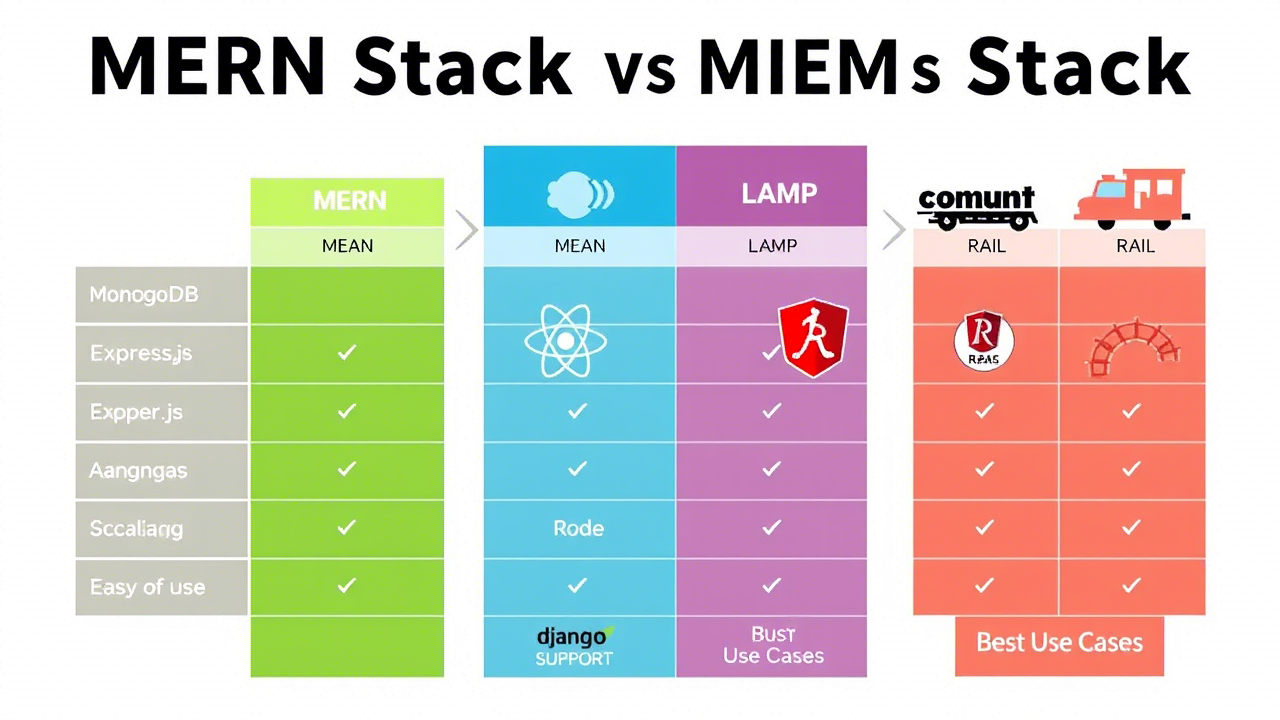
1. MERN vs. MEAN Stack
- Similarities : Both stacks use MongoDB, Express.js, and Node.js. The primary difference lies in the front-end framework—React in MERN and Angular in MEAN.
- Differences :
- React : Offers more flexibility and a component-based architecture, making it easier to reuse code and scale applications.
- Angular : Provides a more opinionated structure, which can be beneficial for large-scale enterprise applications but may feel restrictive for smaller projects.
2. MERN vs. LAMP Stack
- LAMP (Linux, Apache, MySQL, PHP/Python):
- Strengths : Proven reliability, extensive community support, and compatibility with legacy systems.
- Weaknesses : Slower development cycles due to less streamlined integration between components.
- MERN Advantage : Faster development with a unified JavaScript ecosystem, better suited for real-time applications and modern web experiences.
3. MERN vs. Django (Python)
- Django :
- Strengths : Excellent for rapid development, especially for data-driven websites. Built-in admin panel and ORM simplify backend tasks.
- Weaknesses : Less flexible than MERN, particularly for frontend-heavy applications.
- MERN Advantage : Greater flexibility and control over both frontend and backend, ideal for custom web applications.
4. MERN vs. Ruby on Rails
- Ruby on Rails :
- Strengths : Convention over configuration, making it easy to get started quickly. Strong community and rich libraries (gems).
- Weaknesses : Performance can be slower compared to Node.js, and scaling can be challenging for very large applications.
- MERN Advantage : Better performance and scalability, thanks to Node.js's non-blocking I/O model and React's efficient rendering.
Why Choose the MERN Stack?
- Unified Language : JavaScript across the entire stack simplifies development and reduces context-switching.
- Flexibility : React's component-based architecture allows for highly customizable and reusable UI elements.
- Performance : Node.js's event-driven, non-blocking I/O model ensures high performance and scalability.
- Community Support : A vast ecosystem of libraries and tools, along with active community support, makes problem-solving easier.
- Real-Time Applications : Ideal for building real-time features like chat applications, live updates, and collaborative tools.
When to Consider Alternatives
While the MERN stack is powerful, it may not always be the best fit:
- For Data-Driven Websites : Django might be a better choice due to its built-in admin panel and ORM.
- For Enterprise-Level Applications : Angular (MEAN stack) could offer more structure and scalability.
- For Legacy Systems : LAMP might be preferable for maintaining compatibility with existing infrastructure.
Conclusion
Choosing the right tech stack depends on your project's specific needs, team expertise, and long-term goals. The MERN stack excels in flexibility, performance, and ease of use, making it a strong contender for most modern web applications. However, understanding the strengths and limitations of alternative stacks will help you make the best decision for your next project.
So, whether you're building a small startup MVP or a large-scale enterprise application, carefully evaluate your options and choose the stack that aligns with your vision.